.png)
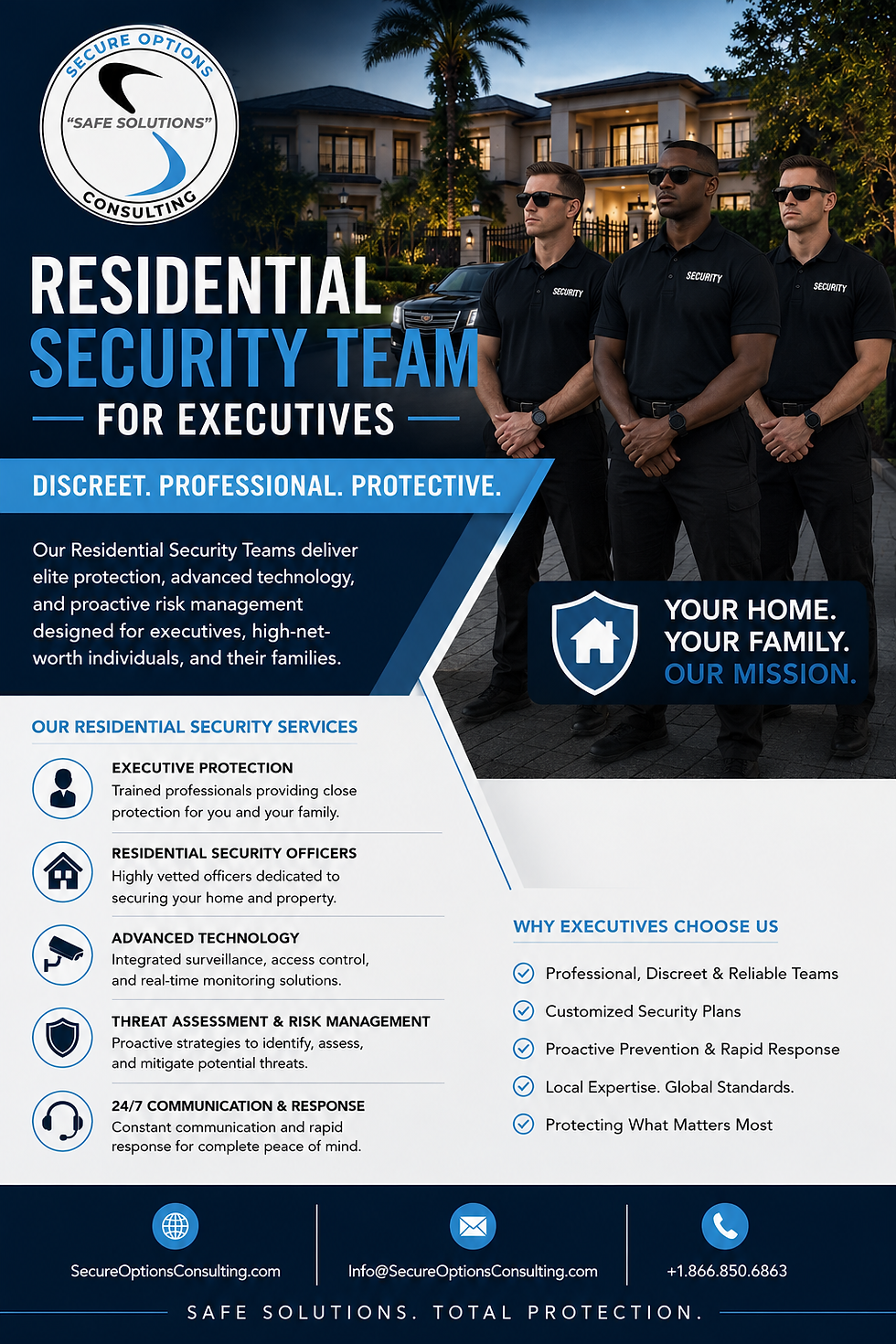
Residential Security Team for Executives

A residence is often the most predictable point in an executive’s routine. It is where family members arrive and depart, household staff work, deliveries accumulate, and personal information can be observed over time. A residential security team for executives addresses that exposure with a protective program designed around the household, property, schedule, and credible threat picture - not a generic guard post.
For executives, high-net-worth families, dignitaries, and other at-risk individuals, residential security is not solely about stopping an intruder at a gate. It is a disciplined risk-management function that identifies vulnerabilities before they become opportunities, maintains a discreet protective presence, and establishes a controlled response when conditions change.
Why Executive Residences Require a Different Security Model
Commercial properties generally have fixed operating hours, formal visitor processes, and defined public and employee areas. A private residence has a different risk profile. Family routines change. Children may have activities and caregivers. Contractors, landscapers, domestic staff, package carriers, and guests can create legitimate but difficult-to-manage access events. The property may also sit in a neighborhood where an obvious security posture would be inappropriate.
For a visible executive or a family with a known business, legal, political, or public profile, residential exposure can include stalking, targeted theft, harassment, unwanted media attention, extortion attempts, protest activity, domestic disputes, or threats originating online. Many incidents do not begin with forced entry. They begin with surveillance, social engineering, a compromised routine, or an individual testing whether access controls are consistently enforced.
A capable program therefore combines physical security, protective intelligence, trained personnel, and clear operating procedures. The objective is to make the residence more difficult to assess, approach, and exploit while allowing the household to continue living normally.
What a Residential Security Team for Executives Does
The right team is sized and structured according to risk. Some clients need a residential security agent during defined hours, while others require 24/7 coverage, a secure residential command function, or coordination with executive protection and secure transportation details. More staffing is not always better. An oversized footprint can disrupt privacy, attract attention, and create unnecessary cost. The appropriate model follows the threat assessment and the family’s operating requirements.
Maintain controlled access without disrupting the household
Residential agents manage who enters the property, why they are there, and whether their access has been confirmed. This can include visitor screening, credential verification, contractor coordination, package procedures, gate and perimeter monitoring, and documented handoffs between shifts.
The process should account for ordinary household life. A family should not need to negotiate security procedures every time a child has a friend visit or a service professional arrives. Clear pre-authorization practices and a designated household point of contact reduce friction while preserving control.
Detect concerning activity early
Visible patrols are only one part of residential protection. Security personnel should recognize pre-incident indicators: repeated unfamiliar vehicles, individuals photographing the property, suspicious delivery patterns, unusual inquiries to staff, attempts to obtain schedules, or online statements that may translate into an in-person concern.
Protective intelligence gives those observations context. When a threat is identified, the team can distinguish between an isolated nuisance and conduct requiring escalation, investigative support, law enforcement liaison, or changes to protective coverage. This prevents both complacency and overreaction.
Prepare the residence for a coordinated response
A residential emergency can develop quickly, whether it involves a suspicious person, medical event, fire, civil disturbance, forced-entry attempt, or credible threat to a family member. The security team should know the property, emergency contacts, evacuation routes, safe locations, alarm and camera systems, and response authorities.
Preparation is valuable because it reduces decision-making pressure during an incident. A written response plan should identify who makes protective decisions, how family members are notified, when emergency services are contacted, and how the principal is moved or sheltered if required. Plans must be practiced and revised when staffing, travel patterns, construction, or threat conditions change.
Coordinate protection beyond the property line
Residential security is strongest when it does not operate in isolation. Agents may coordinate with executive protection personnel, security drivers, household managers, school security contacts, corporate security teams, and local law enforcement when appropriate. The transition from residence to vehicle, workplace, airport, or event is a common point of vulnerability.
This coordination also matters when the principal travels. A residence should not appear unoccupied or unmanaged during extended absences. At the same time, household staff should understand what information may be shared about travel plans, guests, deliveries, and family schedules.
Begin With a Residential Risk Assessment
Effective residential protection starts before personnel are assigned. A professional assessment examines the property layout, perimeter, lighting, access points, neighborhood environment, existing technology, emergency response considerations, staffing patterns, and daily routines. It also considers the principal’s public profile, recent incidents, litigation or employment issues, travel exposure, and available threat reporting.
The assessment should identify both immediate corrections and longer-term improvements. Some vulnerabilities can be addressed through procedural changes, such as limiting who can confirm a family member is home. Others may require physical changes, including improved exterior lighting, camera placement, controlled vehicle access, landscaping adjustments, alarm integration, or secure communications.
Technology supports the program, but it does not replace trained judgment. Cameras can record an event, access-control systems can log entry, and alarms can produce alerts. None of those tools independently determine whether a person at the gate is a verified vendor, a person attempting to gather intelligence, or someone who poses an immediate threat. The team, procedures, and response capability give the technology operational value.
Selecting Personnel for the Residence
Residential assignments demand more than a guard license and a uniform. Personnel work near families, household employees, sensitive conversations, personal assets, and private routines. They must demonstrate sound judgment, discretion, emotional control, and professional communication in addition to security competence.
Experience in executive protection, law enforcement, military, diplomatic security, emergency management, or protective operations can be relevant, but credentials alone do not ensure the right fit. The best personnel are also able to operate calmly in a domestic setting. They know when to be visible, when to remain unobtrusive, and when a small irregularity requires immediate attention.
Background screening, licensing, training verification, supervisory oversight, and clear reporting standards are essential. Depending on the assignment, the program may require armed or unarmed personnel. That decision should be based on applicable law, the threat environment, client preference, property considerations, and the provider’s ability to manage use-of-force policy, training, documentation, and accountability.
Common Gaps That Create Avoidable Exposure
Many residences have quality cameras, gates, and alarms yet still lack a coherent protective plan. The issue is usually not one missing device. It is the absence of consistent procedures and trained people who can interpret what they see.
Common gaps include informal visitor approvals, uncontrolled access by vendors, untrained household staff, inconsistent shift coverage, poor incident reporting, and no plan for family travel or emergencies. Another frequent concern is social-media exposure. Public posts can reveal locations, property features, school activities, travel timing, and family relationships that make targeted surveillance easier.
Security measures should be calibrated carefully. A highly visible posture may be appropriate after a credible threat, during civil unrest, or for a principal with a substantial public profile. In other cases, a low-profile team, unmarked vehicles, and discreet access management better preserve privacy. The correct approach depends on risk, not appearance.
Building a Program That Can Adapt
Residential risk is not static. A promotion, public controversy, legal dispute, family change, major construction project, or new travel pattern can alter the protection requirement quickly. Security programs should be reviewed regularly, with formal reassessment after a threat, incident, or material change in the household’s circumstances.
Secure Options Consulting develops residential protection programs using risk assessment, protective intelligence, close-protection capability, and operational oversight. The goal is not to make a private residence feel like a facility. It is to give the family a prepared, accountable security function that can prevent problems, manage uncertainty, and respond decisively when necessary.
A well-run residential team should become part of the household’s confidence, not its daily burden. When procedures are clear, personnel are qualified, and protection is matched to real risk, the people inside the residence can focus on their lives rather than the vulnerabilities around them.
From the Staff @
Secure Options Consulting, LLC
+1.866.850.6863


Comments