.png)
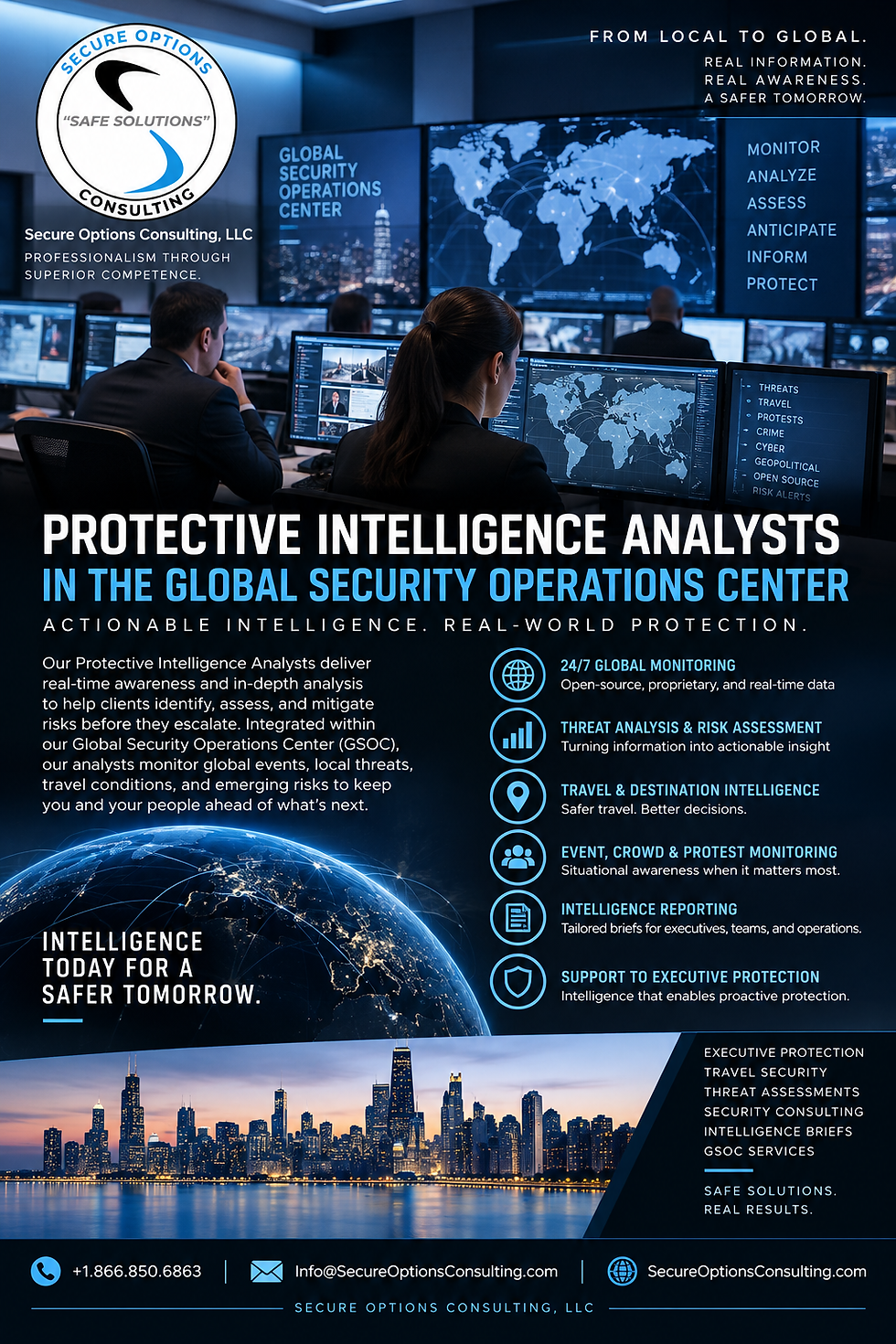
Protective Intelligence Analysts in the Global Security Operations Center

A threatening post, a disrupted travel route, a protest forming near an executive’s hotel, or an employee displaying escalating concerning behavior can change a protection posture quickly. Protective intelligence analysts operating in the global security operations center give security leaders the ability to identify those changes early, assess their relevance, and direct the right response before a concern becomes an incident.
For executive teams, family offices, corporate security departments, and operators with distributed assets, this function is more than monitoring news or social media. It is an intelligence-led process that connects verified information to a specific person, facility, event, itinerary, or business operation. The value lies in disciplined judgment: distinguishing routine noise from a credible threat and providing decision-makers with timely, defensible recommendations.
What Protective Intelligence Adds to a Global SOC
A global security operations center, often called a GSOC, serves as a command-and-coordination capability for an organization’s security environment. It may monitor alarms, access-control events, travel disruptions, weather, civil unrest, emergency calls, and business continuity issues across multiple locations. Protective intelligence strengthens that model by focusing on intent, capability, opportunity, and proximity to protected people and assets.
Traditional monitoring can tell a team that a crowd is developing outside a building. A protective intelligence analyst asks different questions: Is the event directed at the organization or an executive? Are known threat actors involved? Is the crowd likely to affect entry and exit routes? Does the executive have a public-facing engagement nearby? What protective measures should change now?
That distinction matters because not every adverse mention, protest, or online comment warrants a protective response. Overreaction can disrupt business operations, create unnecessary visibility, and erode confidence in the security program. Underreaction can leave a principal, family member, employee, or facility exposed. Effective analysis supports proportionate action.
The Analyst’s Operating Role
Protective intelligence analysts are not passive observers. Their work begins with a clear protection requirement: who or what requires monitoring, what risks are most relevant, and what decisions the security team needs to make. They build threat profiles and collection priorities around real exposure rather than generic alerts.
For a corporate executive, priorities may include hostile fixation, travel-related threat conditions, event exposure, executive communications, and emerging labor or activist activity. For a family office, the focus may include residential exposure, family-member travel, social media oversharing, kidnapping risk, or unwanted attention linked to wealth and visibility. For a critical-infrastructure operator, analysts may track credible threats to facilities, insider concerns, activist planning, regional crime patterns, and disruptions that could affect continuity of operations.
The GSOC gives analysts a central place to receive and evaluate information from security personnel, executive protection teams, investigations, alarm systems, incident reports, travel providers, public reporting, and approved digital sources. The analyst then turns those inputs into a usable assessment. This may be a short operational alert, a travel threat brief, a case file supporting an investigation, or a recommendation to adjust staffing, routes, schedules, or protective coverage.
Collection Must Serve a Defined Mission
More information does not automatically improve security. Excessive monitoring produces false positives, delays response, and can raise privacy and governance concerns. Collection must be lawful, relevant, and tied to an established protective purpose.
A mature program establishes clear thresholds for escalation and documents why a concern was assessed as low, moderate, or high risk. It also identifies who has authority to make operational decisions. Analysts provide the intelligence picture; protective leaders, corporate stakeholders, and clients determine the appropriate response within the established plan.
This discipline is particularly important when monitoring online content. A hostile statement may be disturbing but still lack specificity, capability, or access to the protected person. Conversely, a seemingly minor post can become significant when it includes location details, prior contact, demonstrated surveillance, or a pattern of fixation. Context is the difference between raw information and protective intelligence.
From Intelligence to Protective Action
The effectiveness of a GSOC depends on what happens after a threat is identified. An analyst’s assessment should lead to a defined operational choice, not simply another report in an inbox.
When a credible concern arises, the response may include discreet verification by investigative personnel, a protective advance at an upcoming venue, enhanced residential security, route adjustments, secure transportation, liaison with local law enforcement, or a change to executive travel plans. In other cases, the correct response is continued monitoring with no visible change to the principal’s routine.
There is no universal response standard because the right action depends on the threat, the principal’s risk tolerance, the location, and the operational consequences of disruption. A high-profile executive attending a contentious public event requires a different posture than a family traveling privately through a region experiencing general civil unrest. Both situations require preparation, but the protective objective and staffing model may differ.
Protective intelligence also improves coordination during fast-moving events. If severe weather, civil unrest, or a security incident affects a business district, analysts can provide a common operating picture to executive protection teams, facility leadership, mobile patrols, and client decision-makers. That shared picture reduces conflicting information and supports a measured response.
Protective Intelligence Analysts Operating in the Global Security Operations Center
The most capable analysts combine investigative rigor with an understanding of field operations. They recognize that a report is only useful if it reaches the people who can act on it, in language that makes the decision clear.
A strong intelligence product answers several operational questions: What happened? Why does it matter to this client or operation? How reliable is the information? What is the assessed level of risk? What actions should be considered, and how quickly? It should also state what is not known. False certainty is a security weakness, especially when decisions involve executive movement, public events, or family safety.
Analysts need working familiarity with protective operations, threat assessment principles, investigations, emergency management, and local conditions. They must understand how a route change affects a protective detail, how a facility lockdown affects tenants and visitors, and how a travel warning affects a principal’s schedule. That operational awareness prevents intelligence from becoming detached from the realities of protection.
Credentialed expertise is especially valuable in high-consequence environments. Personnel with backgrounds in law enforcement, military service, diplomatic protection, executive protection, investigations, or enterprise security risk management bring practical perspective to ambiguous situations. Their experience does not replace analysis, but it improves the quality of questions asked and the feasibility of recommended actions.
Governance, Privacy, and Discretion
Protective intelligence programs handle sensitive information about individuals, locations, business operations, and sometimes family members. Discretion is therefore an operating requirement, not simply a client preference.
Organizations should establish access controls, retention standards, documentation practices, and clear procedures for handling personally identifiable information. Analysts should work from defined collection authorities and avoid gathering information that does not serve a legitimate security purpose. When a concern involves an employee, customer, or other internal stakeholder, coordination with legal counsel, human resources, and appropriate leadership may be necessary.
Confidentiality also affects reporting. A broad distribution list can compromise sensitive protective measures or expose a principal’s movements. The right audience for a protective intelligence report may be limited to a corporate security director, executive protection leader, designated family office representative, or incident-management group. Information should move on a need-to-know basis while still reaching those responsible for action.
Building a Program That Fits the Risk
Not every organization needs a 24-hour global security operations center. A regional business may need focused threat-monitoring support during executive travel, labor activity, litigation, public events, or periods of heightened concern. A multinational organization may require continuous monitoring and formal escalation protocols across time zones. A family office may benefit from a tailored protective intelligence program integrated with residential security, travel security, and close protection.
The right model begins with a risk assessment. Identify the people, assets, locations, and operations that matter most; define likely threat scenarios; establish notification thresholds; and determine how intelligence will reach protective personnel and client leadership. Exercises are useful because they expose practical gaps before a real incident does. Can the analyst reach the executive protection detail after hours? Who approves a travel change? Does the residential team know what to do if a concerning person appears near the property?
Secure Options Consulting applies this intelligence-informed approach across executive protection, investigations, travel security, residential protection, workplace violence security, and enterprise security risk management. The objective is not to create a larger security footprint than necessary. It is to create a prepared, defensible program that can adjust when conditions change.
The strongest protective intelligence capability is often invisible to the people it protects. Its success is measured in informed decisions, avoided exposure, and the confidence that a capable team is watching the conditions that could matter next.
From the Staff @ Secure Options Consulting, LLC


Comments