.png)
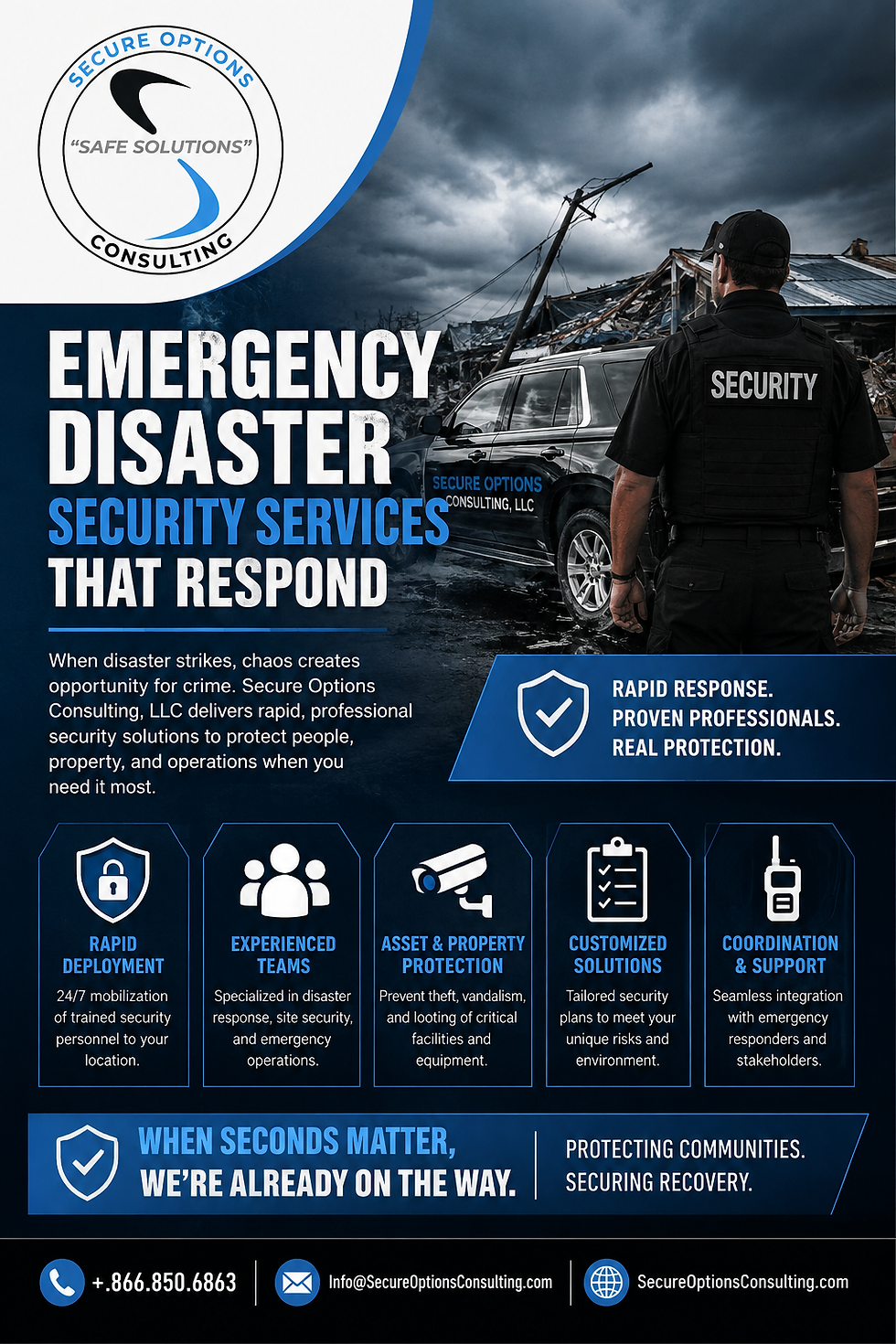
Emergency Disaster Security Services That Respond

A flooded loading dock, wind-damaged perimeter fence, prolonged power outage, or civil disturbance can change a familiar property into an unsecured operating environment within hours. Emergency disaster security services address that gap by placing trained personnel, clear command structure, and intelligence-led protective measures where normal controls have failed or been strained.
For corporate leaders, property managers, family offices, and critical-infrastructure operators, the objective is not simply to put guards at a damaged site. It is to protect life safety, preserve access for first responders, prevent theft and unauthorized entry, support continuity decisions, and document conditions that may later affect insurance, regulatory, operational, or legal matters.
What Changes After a Disaster
A disaster often creates several security problems at once. Electronic access control may be offline. Cameras may be inoperable. Doors, gates, windows, fences, and utility areas may be exposed. Employees, tenants, contractors, displaced residents, media personnel, and opportunistic actors can arrive at the same time with different reasons for seeking access.
Those conditions require more than a standard post order. They require an immediate understanding of what is known, what remains uncertain, and which threats present the greatest consequence. A hospital, high-rise residential property, distribution center, executive residence, retail location, school, production site, or utility facility will not have the same priorities after an incident. The security response must match the location, population, asset profile, and operating status.
The first hours are especially consequential. Poorly controlled access can interfere with fire, law enforcement, emergency management, utility, and restoration crews. A loose perimeter can allow property loss, evidence contamination, vandalism, or injury. A visible but uncoordinated guard presence can also create false confidence if personnel have not been given authority, communications procedures, escalation protocols, and a defined mission.
Emergency Disaster Security Services Begin With Command
Effective emergency disaster security services start with a rapid assessment and a single operational picture. Before deploying personnel broadly, the security lead should identify life-safety hazards, incident boundaries, available entrances, damaged areas, critical equipment, known threats, and the agencies or site representatives directing emergency operations.
Security must work within the incident environment, not compete with it. If fire personnel are conducting suppression or overhaul operations, access control must preserve their routes and staging areas. If law enforcement is investigating a criminal act or managing a disturbance, site security needs disciplined coordination and defined reporting channels. If utility crews are restoring power, gas, water, or communications, credential verification and escort procedures should enable the work without opening the property to unverified individuals.
A practical response structure assigns responsibility for site command, field supervision, client communications, documentation, and relief staffing. It also establishes how personnel will report incidents, request support, transfer shifts, and respond if conditions escalate. This level of organization matters when operations continue overnight, across multiple buildings, or through several days of recovery.
The First Operational Priorities
The order of priorities depends on the event, but life safety comes first. Security personnel may assist with access control, evacuation support, accountability procedures, traffic direction, and keeping bystanders away from dangerous areas. They should not be asked to perform technical rescue, enter unsafe structures, or assume responsibilities reserved for fire, medical, law-enforcement, or utility professionals.
Once immediate life-safety concerns are addressed, the team can establish a controlled perimeter. This may involve securing entrances, creating vehicle checkpoints, placing mobile patrols along damaged fence lines, monitoring loading docks, and protecting temporary staging or shelter areas. At a larger site, separate zones may be needed for emergency responders, essential employees, vendors, residents, media, and the public.
The third priority is continuity. Decision-makers need reliable information about who is entering, what has occurred, which systems are operating, and where risks are increasing. Accurate activity logs, incident reports, photographs when authorized, and shift briefings create a defensible record while helping the client make sound recovery decisions.
Matching the Security Response to the Risk
The most effective response is scaled to the threat rather than selected from a fixed package. An unarmed security team may be appropriate for a storm-damaged commercial property where the principal needs are access control, safety observation, and contractor management. Armed personnel, off-duty law enforcement, or specialized executive protection may be warranted when credible threats, civil unrest, high-value assets, hostile termination concerns, or targeted individuals are involved.
This is where risk assessment is more useful than assumptions. A damaged luxury retail location may need visible deterrence and inventory protection. A family office may need discreet residential security, secure transportation, and protective intelligence concerning a principal's exposure. A critical-infrastructure facility may require enhanced perimeter patrols, credentialing procedures, and coordination with operations personnel to keep essential services moving.
Visibility is also a deliberate choice. Highly visible personnel and marked patrol units can deter opportunistic intrusion and reassure occupants. In other circumstances, a lower-profile posture protects privacy, avoids drawing attention to a principal or asset, and reduces disruption to a sensitive operation. The correct approach depends on the client, the nature of the incident, local conditions, and the assessed threat.
Staffing Is Only One Part of the Response
Emergency staffing without supervision, communications, and planning is a limited answer to a complex problem. Personnel need site-specific direction: what to protect, who may enter, which hazards to avoid, when to call 911, how to report suspicious activity, and how to handle media or public inquiries. They also need dependable relief, meals, transportation, equipment, and a method for staying informed as conditions change.
A trained field supervisor provides quality control and keeps post coverage aligned with the mission. When a perimeter must be adjusted because floodwater rises, a generator fails, a crowd forms, or a restoration crew needs a new access point, the supervisor should be able to act within an established command framework and promptly notify the client.
For extended incidents, fatigue becomes a real security risk. Long shifts, poor lighting, adverse weather, and uncertainty can degrade awareness and judgment. A professional provider plans for shift rotations, welfare checks, supervision, and additional resources before those pressures create a coverage failure.
Protecting Information, Evidence, and Reputation
Disaster conditions can expose more than physical assets. Unsecured offices may contain employee records, client files, financial information, proprietary equipment, or regulated materials. A security plan should identify sensitive areas and determine whether they require restricted access, escorts, inventory controls, or preservation for investigation.
If a criminal act, suspicious fire, workplace violence incident, or targeted threat is involved, preserving the scene matters. Security personnel should control access, maintain detailed logs, observe and report, and avoid disturbing potential evidence unless life safety requires action. Coordination with law enforcement and counsel may be necessary before cleanup, repair, or reentry proceeds.
Reputation also carries operational value. Employees and tenants will judge leadership by whether communication is calm, access is orderly, and safety expectations are clear. Security personnel are often the most visible representatives at a disrupted site. Professional conduct, confidentiality, and consistent enforcement help reduce confusion without creating unnecessary friction.
Recovery Requires a Planned Transition
The need for emergency coverage rarely ends when the immediate hazard passes. Recovery may involve days or weeks of repairs, temporary closures, reduced staffing, equipment deliveries, insurance inspections, and changing access requirements. A site can remain vulnerable while it appears to be returning to normal.
The transition plan should define what conditions allow security measures to be reduced. Examples include restored access-control systems, repaired perimeter barriers, stable utility service, completed inventory, resumed management coverage, or a reduction in credible threats. The goal is not to keep emergency resources in place indefinitely. It is to reduce them responsibly as risk decreases.
A post-incident review is equally valuable. It should examine whether access points held, communication channels worked, staffing was adequate, critical assets were properly identified, and decision-makers received timely information. Those findings can improve emergency action plans, business continuity procedures, residential protocols, travel security planning, and future guard-force operations.
Secure Options Consulting approaches these events as a risk-management function supported by protective capability, investigative awareness, and operational discipline. That approach helps clients move from immediate stabilization to controlled recovery without treating security as an afterthought.
When a disaster disrupts normal operations, the strongest next step is a clear request for help: identify the site, the current hazards, who is at risk, what must remain protected, and who has authority to make decisions. Those details allow the right security response to arrive with purpose, not just presence.
From the Staff @ Secure Options Consulting, LLC


Comments