.png)
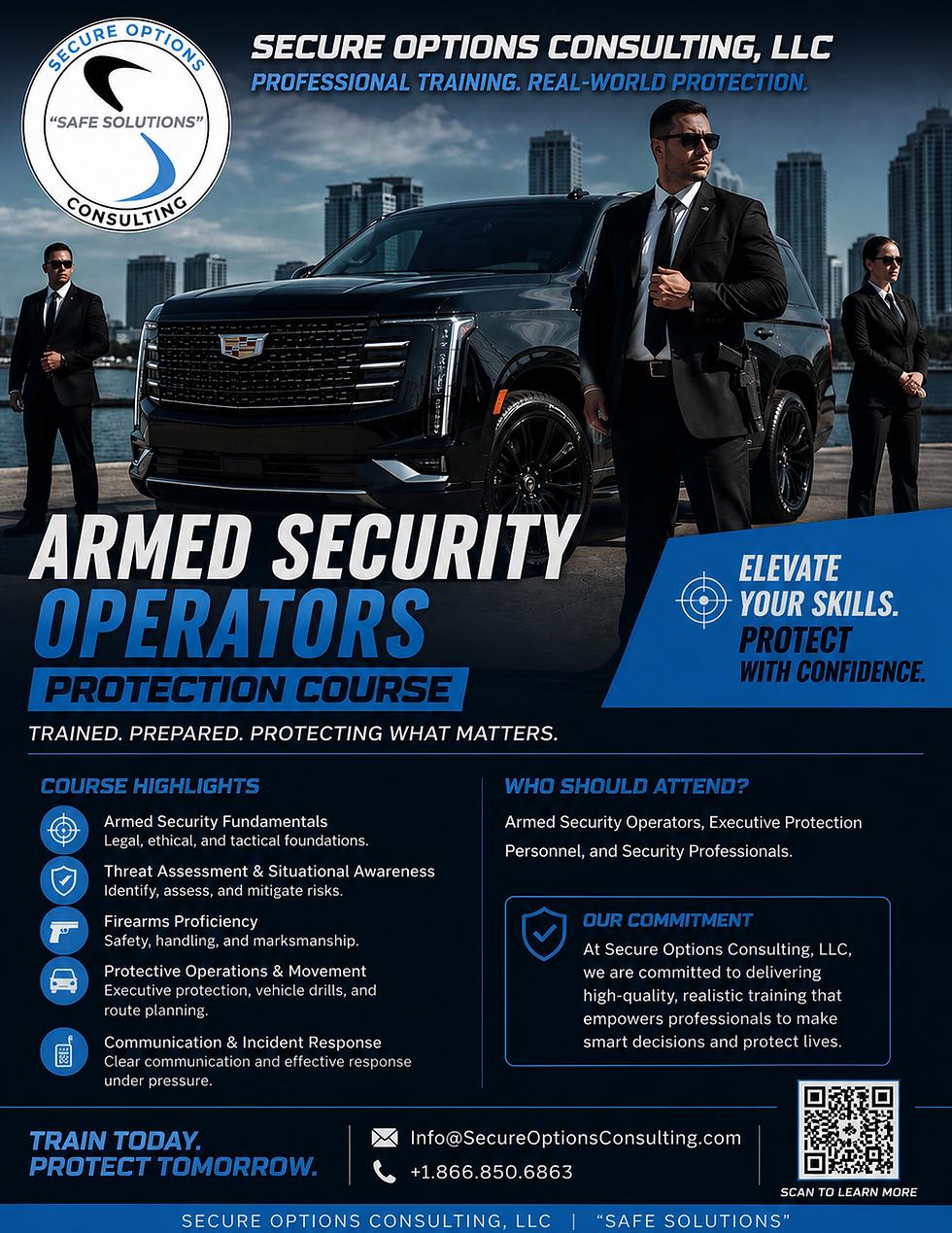
Armed Security Operators Protection Course

A firearm does not make a protection program capable. In a close-protection detail, at a corporate site, or during high-value transport, the armed security operators protection course a professional completes should prepare them to recognize danger early, make lawful decisions under pressure, and protect life without creating avoidable risk for the client, public, or team.
For organizations and private clients, course selection is not a credentialing exercise. It is a due-diligence decision. The quality of training influences how an operator communicates, positions, documents incidents, controls a scene, works with law enforcement, and responds when a situation moves from concern to immediate threat.
What an Armed Security Operators Protection Course Should Deliver
A credible course goes well beyond qualification on a static range. Firearms proficiency matters, but it is only one component of professional armed protection. The operator must understand when not to draw, when to move a principal or staff member away from a developing problem, and how to preserve decision-making space before force becomes a consideration.
The strongest programs integrate protective operations with legal, medical, and communication disciplines. They treat armed work as a serious responsibility within a broader risk-management function, not as a show of force. This distinction is especially important for executive protection, residential security, sensitive corporate environments, luxury retail, houses of worship, and events where discretion and public confidence are part of the mission.
Training should also reflect the assignments an operator is likely to receive. A professional assigned to secure transportation faces different decisions than an officer at a high-rise lobby, a residential estate, or a workplace violence response post. The fundamentals remain consistent, but the tactics, movement patterns, communications, and escalation concerns must fit the operating environment.
Legal Authority and Use-of-Force Judgment
An armed operator needs a practical understanding of applicable state and local law, licensing requirements, agency policy, and the limits of private-security authority. Legal instruction should not be abstract. It should be connected to realistic protective scenarios: a trespasser refusing to leave, an assault in progress, a weapon report at a venue entrance, a suspicious person near a residence, or a confrontation involving an executive during travel.
Good instruction emphasizes articulation. After an incident, an operator may need to explain what they observed, why they perceived an imminent threat, what de-escalation options were available, what actions were taken, and how they rendered aid or secured the scene. Clear reports and accurate statements protect clients, personnel, and the integrity of any subsequent investigation.
Use-of-force training should reinforce necessity, proportionality, avoidance where feasible, and the duty to reassess continuously. A situation can change in seconds. Professional operators understand that the objective is to stop an immediate threat and move people to safety, not to prolong a confrontation or pursue a role beyond their authority.
Firearms Skills That Hold Up Under Stress
Live-fire qualification is necessary, but a passing score alone does not establish operational readiness. A course should evaluate safe gun handling, secure holster use, target discrimination, weapon retention, low-light considerations, malfunction response, judgment, and the ability to communicate while managing a firearm.
The training environment should also address the realities of armed work around noncombatants. Executive teams, family members, employees, guests, hotel staff, and event attendees may be only feet away when a threat emerges. Operators must be able to identify backgrounds, manage angles, move others from danger, and avoid tunnel vision.
Scenario-based exercises are valuable because they reveal whether an individual can think beyond the firearm. A verbal dispute may require a protective reposition, an emergency call, or a coordinated exit rather than a weapon presentation. A suspicious package may require isolation and evacuation. A medical emergency may demand immediate care while a second operator maintains security. The right response depends on the facts, the environment, and the available resources.
Protection Training Must Include Prevention
The most successful protective operation is often the one where force is never needed. That outcome begins with advance work: threat assessment, route planning, site surveys, protective intelligence, communications planning, emergency contacts, and clearly defined responsibilities.
An armed security operators protection course should teach personnel to spot pre-incident indicators without treating every unusual behavior as a criminal threat. Fixation, surveillance, unauthorized access attempts, hostile communications, escalating domestic conflict, insider grievances, and repeated boundary testing can all warrant attention. The proper response may include documentation, reporting, adjusted procedures, investigative follow-up, or engagement with law enforcement.
For corporate security leaders, this preventive mindset supports enterprise security risk management principles. Training should help personnel connect an observed concern to a defensible process: identify the risk, assess its credibility and potential impact, apply proportionate controls, communicate with stakeholders, and review outcomes. Armed personnel are more effective when they are part of that structured program rather than isolated at a post.
Medical Readiness and Immediate Care
Violence, accidents, and medical emergencies can create similar time-critical demands. An armed protection course should include current emergency medical training appropriate to the role, including hemorrhage control, basic trauma response, tourniquet application, scene safety, communication with emergency services, and transfer of care.
Medical readiness is not secondary to protection. In a high-consequence incident, the first trained person on scene may be the difference between a survivable injury and a fatal one. Operators should know where medical kits are located, what equipment they carry, how to request aid, and how to continue protecting others while care is underway.
Training should also include post-incident responsibilities. Once the immediate danger is controlled, personnel may need to establish a perimeter, preserve evidence, identify witnesses, make notifications, complete reports, and support the client through the first hours of disruption. Calm, disciplined actions during this phase can materially affect recovery, legal exposure, and public confidence.
How Clients Should Evaluate Training Standards
Clients should ask direct questions before assigning armed personnel to sensitive work. Is the course designed for private protection or primarily for basic licensing? Does it include scenario-based decision-making, protective movement, legal instruction, medical readiness, report writing, and de-escalation? Are instructors qualified through relevant law enforcement, military, protective-service, medical, or security leadership experience?
Credentials deserve scrutiny, but they should be examined in context. A decorated background can be valuable, yet it does not automatically translate to private-sector protection. The operator must understand client service, confidentiality, liability, property rules, local licensing, and the practical limits of a private security role. The best training brings those disciplines together.
Course recency matters as well. Skills degrade, laws change, and threat patterns evolve. A responsible program includes documented recurrent training, supervisory review, fitness standards where appropriate, and lessons learned from exercises and real-world operations. For specialized assignments, training should be supplemented with site-specific briefings and written post orders.
Secure Options Consulting approaches armed protection as one layer within a tailored protective program. Depending on the risk, that program may also require secure transportation, protective intelligence, threat assessment, residential procedures, unarmed personnel, mobile patrols, or coordination with corporate leadership and public-safety partners. The goal is not to place an armed person wherever concern exists. The goal is to apply the right capability to the actual threat.
The Standard Is Judgment, Not Presence
Armed operators may be called upon when the consequences of failure are severe. That reality requires more than confidence and equipment. It requires disciplined judgment, controlled communication, lawful authority, sound tactics, medical competence, and the maturity to reduce tension whenever possible.
For a family office, executive team, facility operator, or event organizer, the most useful question is not whether an operator has attended a course. Ask whether their training prepares them to prevent foreseeable problems, protect people decisively when necessary, and remain accountable throughout the operation. That standard creates the peace of mind serious protection is meant to provide.
Contact us to review our course lesson plan and to see if it fits your company's needs.
From the Staff @
Secure Options Consulting, LLC
+1.866.850.6863


Comments