.png)
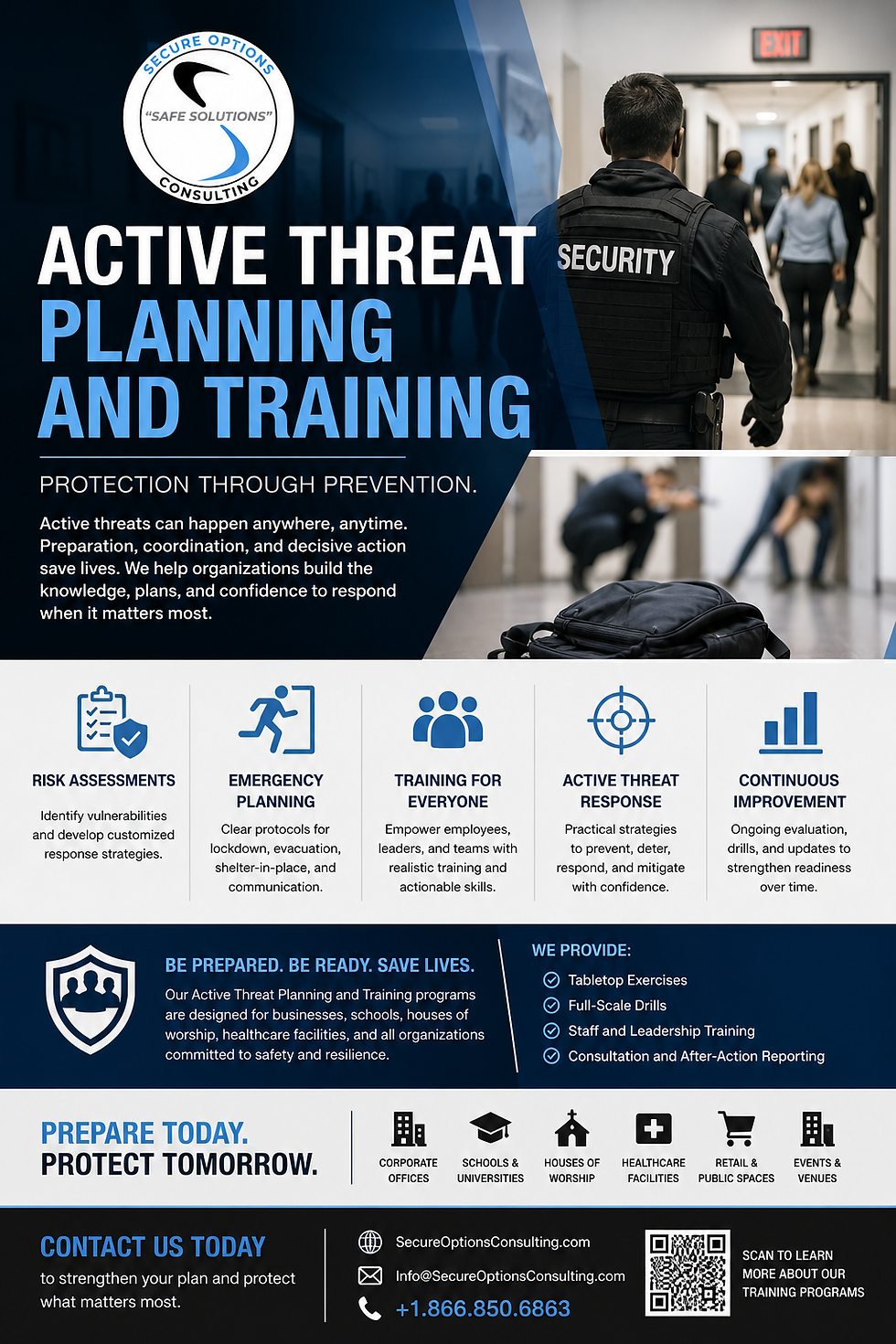
Active Threat / Shooter Response Planning & Training
- Secure Options

- Aug 2
- 6 min read
A school administrator receives a concerning report about a former studen. A property manager learns that a tenant has made threats against staff. An executive team faces a disruptive termination, a public demonstration, or a credible social media post aimed at a facility. In each case, active assailant response planning must begin before an emergency call is made. The objective is not to produce a binder that sits on a shelf. It is to establish defensible decisions, trained roles, and practical options that protect life while supporting continuity of operations.
A useful plan recognizes a difficult reality: no two sites, populations, or threats are identical. A downtown high-rise, manufacturing campus, house of worship, retail location, school, private residence, and public event require different protective measures. The strongest programs apply enterprise security risk management principles to the organization’s actual people, places, vulnerabilities, and operating constraints.
What Active Assailant Response Planning Must Address
An active assailant plan is broader than an evacuation map or a single training presentation. It connects prevention, immediate response, emergency coordination, and recovery. It should also account for the period before violence occurs, when concerning behavior, grievances, access issues, and intelligence indicators may offer opportunities for intervention.
Leadership should define who owns the program and who has authority to make time-sensitive decisions. That includes decisions about temporary closures, access restrictions, employee removal, security posture changes, notification language, and coordination with law enforcement. When authority is unclear, organizations often lose critical time debating who can act.
The plan must also be usable under stress. Staff members will not consult a lengthy policy document while frightened, moving people to safety, or assisting injured colleagues. The operational portion should be clear, role-specific, and supported by concise job aids, drills, and recurring training. Detailed annexes can address command structure, site diagrams, contact rosters, and recovery procedures.
Start With a Site-Specific Risk Assessment
Generic active assailant materials can provide a baseline, but they cannot identify the conditions that make one facility more exposed than another. A site-specific risk assessment examines how people enter, move through, and leave a property. It considers public access, visitor management, parking areas, delivery routes, stairwells, reception areas, vulnerable gathering spaces, camera coverage, communications capability, and the reliability of door hardware.
The assessment should also look beyond physical security. Organizations need to understand their threat environment: workforce disputes, domestic violence spillover, targeted individuals, civil unrest, public-facing controversy, theft activity, online threats, and prior incidents. Protective intelligence and threat assessment processes are especially valuable when a concern involves fixation, escalation, direct threats, or unusual interest in personnel or locations.
There are trade-offs. A luxury retail store cannot operate like a restricted government facility, and a house of worship should not create an atmosphere that discourages community participation. The appropriate safeguards depend on the risk, the organization’s mission, and the consequences of failure. Effective planning balances deterrence, detection, response capability, and a respectful experience for legitimate occupants and visitors.
Identify the Decisions That Cannot Wait
The most valuable planning conversations address decisions that must be made in minutes, not days. Who can initiate a lockdown or evacuation? Who contacts 911 and what information must be conveyed? How are people notified if cellular service is congested? Who meets responding officers, if doing so is safe? What happens if the incident occurs during a shift change, event load-in, or school dismissal?
These questions expose gaps in staffing, technology, and command. They also help organizations avoid relying on one executive, one security manager, or one communication channel. Redundancy matters because the person assigned to act may be absent, injured, or unable to reach the site.
Build Prevention Into the Response Program
The phrase “active assailant” can lead organizations to focus only on the moment of attack. That is too narrow. Prevention begins with a culture in which employees, tenants, students, contractors, and family members know how to report concerning behavior without fear of dismissal or retaliation.
Reports should move through a defined evaluation process. Not every conflict is a threat, and not every troubling statement warrants the same response. A qualified multidisciplinary team can assess behavior, context, access to potential targets, known stressors, and signs of escalation. The result may be a welfare check, human resources action, enhanced security, a protective order strategy, law enforcement notification, or continued monitoring. The response should be proportionate, documented, and coordinated.
Access management is another preventive control. Organizations should know who has keys, credentials, alarm codes, and access to sensitive areas. Terminations, resignations, contractor departures, and role changes should trigger prompt credential review. For higher-risk situations, security and human resources should coordinate the separation process, transportation arrangements, post-separation communications, and monitoring of the location.
Prepare People for Clear, Lawful Action
Training should give personnel practical choices without suggesting there is a universal response. Depending on the facts, people may need to evacuate, secure in place, shelter away from danger, assist others when safe, provide accurate information to first responders, or follow law enforcement commands. The correct action depends on proximity to the threat, available exits, the needs of others, and rapidly changing conditions.
Training should be tailored by role. Front-desk personnel, supervisors, event staff, facilities teams, executive assistants, and security officers face different responsibilities. A security officer may need to manage access, communicate observations, and guide responders. A floor warden may need to account for occupants. A senior leader may need to authorize an operational shutdown and communicate with stakeholders. Clarity reduces hesitation.
Exercises should test the plan without creating unnecessary alarm or operational disruption. Tabletop exercises are particularly effective for leadership teams because they force discussion about incomplete information, conflicting priorities, media attention, family notifications, and business continuity. Functional drills can test communications, accountability, and coordination with local public safety partners. The purpose is to identify weaknesses and correct them, not to grade participants on a scripted performance.
Strengthen Communications and Emergency Coordination
During a violent incident, poor communication can amplify harm. Organizations need pre-approved emergency messages that are short, plain, and adaptable. They should identify the nature of the emergency, the location if known, the immediate protective action, and where to obtain updates. Messages must be accessible to employees, visitors, contractors, and those with language or disability considerations.
A layered communication approach is preferable to reliance on a single platform. Mass notification tools, public-address systems, radios, text messaging, direct calls, and trained security personnel can each have a role. The plan should establish who sends alerts, how messages are verified, and how misinformation is managed.
Coordination with law enforcement, fire, emergency medical services, and property management should occur before an incident whenever possible. First responders benefit from current site information, access details, floor plans, and a clear understanding of who can provide accurate facility intelligence. For complex properties and major events, an emergency operations structure may be necessary to coordinate security, medical support, transportation, public information, and executive decision-making.
Plan for Recovery Before It Is Needed
The emergency does not end when the immediate threat is stopped. Organizations may need to account for personnel, preserve evidence, support investigations, communicate with families, arrange counseling, manage media interest, restore secure access, and decide whether operations can resume. Leaders should anticipate these needs before a crisis places them under intense scrutiny.
Recovery planning also requires discretion. Employees, tenants, students, and clients may have different privacy needs. A public statement that is appropriate for a large venue may be unsuitable for a family office, residential property, or executive protection client. Communications should be accurate, compassionate, and coordinated with investigators without releasing sensitive information.
After-action reviews should examine what happened, what worked, and what needs to change. The review is not merely administrative. It should result in tracked corrective actions, assigned owners, deadlines, and validation that improvements were made. A plan that is not maintained will gradually become unreliable as personnel, facilities, vendors, and threats change.
A Plan Is a Capability, Not a Document
Effective active assailant response planning combines informed risk assessment, protective intelligence, trained personnel, physical security, emergency communications, and disciplined leadership. It should be reviewed after material changes such as a move, expansion, leadership transition, high-profile event, employee conflict, or credible threat.
For organizations with elevated exposure or complex operations, an independent assessment can provide a clearer view of blind spots and help align security, human resources, legal counsel, facilities, and executive leadership. Secure Options Consulting approaches this work as a tailored protective program, informed by public-safety experience and the realities of the client’s environment.
The most reassuring plan is not the one with the most pages. It is the one people understand, leaders can activate, and the organization has practiced before the moment it is needed.
From the Staff @
Secure Options Consulting, LLC
+1.866.850.6863


Comments